• Blog
  • Blog Index
  • Video Work
  • About
Menu

Thomas Bardenett

Urban Planning - Writer - Filmmaker
  • Blog
  • Blog Index
  • Video Work
  • About
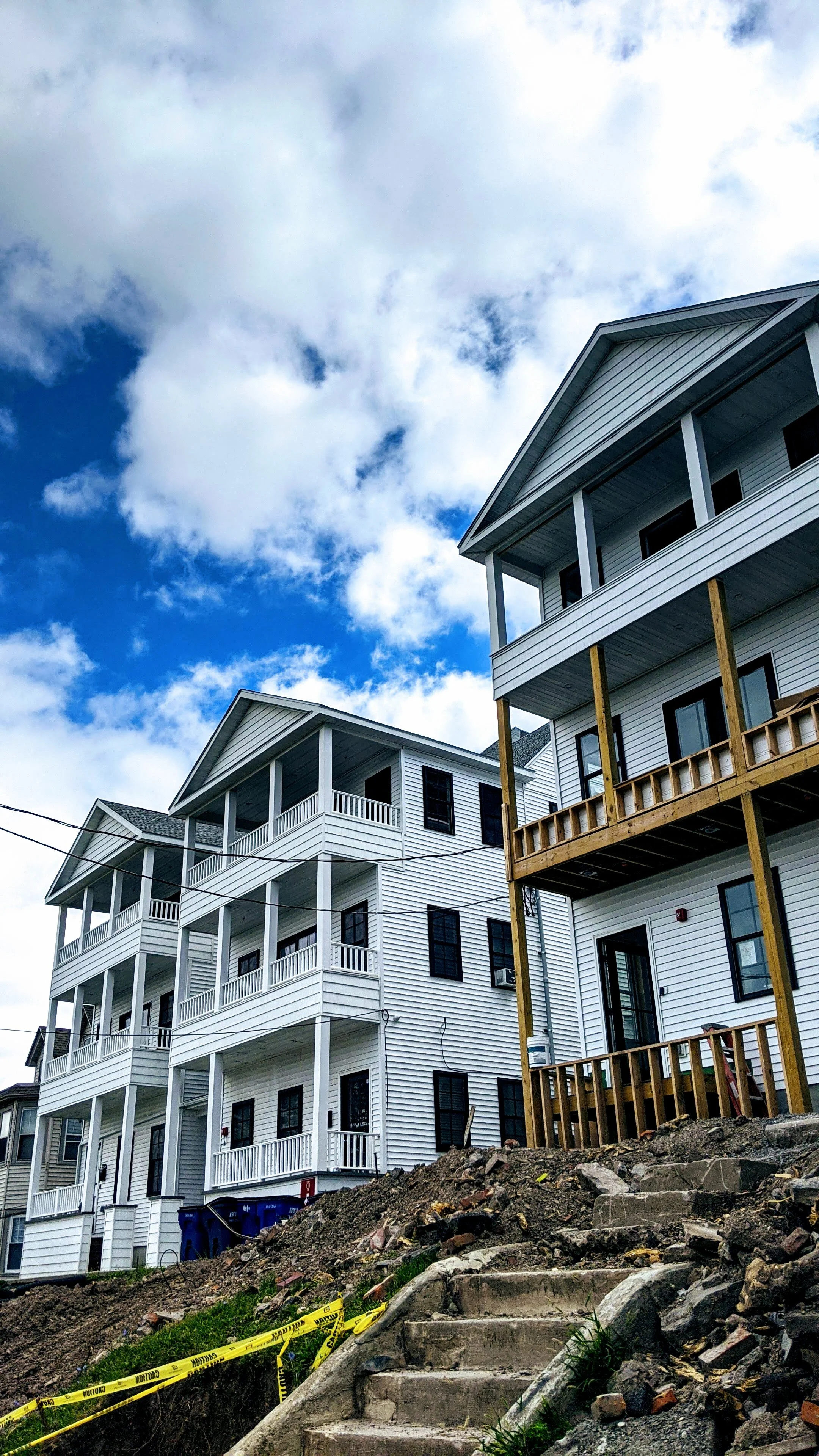
A combination of single-family and multi-family homes in Syracuse’s Tipp Hill neighborhood.

A combination of single-family and multi-family homes in Syracuse’s Tipp Hill neighborhood.

To Fight the Climate Crisis We Need: A New "Standard" American Home

August 11, 2020

For the summer of 2020 I will be releasing a series of articles reflecting on some of the things cities, and urban planners specifically, can be advocating and planning for to help in our fight against the climate crisis. These pieces will reflect on our transportation networks, the need for urban living, and protecting our natural resources while bringing them into the city. While these are not comprehensive of everything that needs to be done to turn the tide of this crisis, they will provide a different vision of what our world could be like if we commit to a different form of development.


Single-family zoning found itself in the spotlight over the summer as people began to consider its racial origins through redlining practices and federal/local subsidies. Others began to turn a more critical eye towards this suburban ideal in the name of conservative economic practices, noting that the suburban experiment’s highly subsidized nature and over regulated zoning policies should upset anyone who claims to want less government interventions in private property. You can also look to the negative health effects associated with suburban living, primarily from the more sedentary lifestyle commuting requires and the increased stress levels driving produced. All of these arguments are valid and should be considered when evaluating where we choose to live, how our cities/towns choose to regulate private property, and where our tax money is sent. But we must also consider the impact our housing choices have on the environment, and perhaps living in “greener pastures” is actually the least “green” thing you can do. 

View fullsize Single-Family Zoning in NYC
Single-Family Zoning in NYC
View fullsize ReZone Syracuse Map
ReZone Syracuse Map

First, to alleviate the concern that I’m advocating for all single family homes to disappear. Eliminating single-family only zoning would simply allow for two-family, three-family, or even four-family homes to be built in every neighborhood, along with single-family homes. Last year, Minneapolis did just that, with an eye on breaking down racial and economic barriers that have been in place for nearly a century. This has been a crucial piece needed to improve access to affordable homes across the city. Many would be surprised to know that New York City still has large areas zoned for single-family only, even amidst an affordable housing crisis. The City of Syracuse continues to perpetuate the use of single-family only zoning in their ReZone project, as many residents argue about protecting the “character of the neighborhood,” which is a common racial dog whistle. Any concern for “neighborhood character” is moot since many multi-family homes look very similar to their single-family counterparts. 

Now, if we look at single-family zoning, and suburban living as a whole, from an environmental perspective the issues mostly arise from the consumption and destruction of resources. Over the last century the average American home has grown significantly in size (from around 1300 sqft. in 1960 to nearly 2700 sqft. in 2014), and many have taken up larger and larger lots. While large lot size requirements grew out of racial and economic segregationist policies, they have also resulted in pushing people further and further apart. Due to both of these factors, emissions related to travel are significantly higher in suburban areas. A report by Ed Glaeser and Matthew Kahn noted that, when controlling for family size and income, gas consumption per year per family decreases by 106 gallons when population density doubles. To showcase just how different our cities and suburbs are built, consider that Syracuse’s citywide density (5,604 people per sq. mile) is nearly five times as dense as its most populous suburb, Clay (1,216 people per sq. mile). Or, you can look at some of Syracuse’s inner ring suburbs, Geddes and Salina, where Syracuse is nearly three times as densely populated (1,813 and 2,186 people per sq. mile respectively), or more than double the density of the surrounding villages, like Baldwinsville (2,293 people per sq. mile). This emissions calculation doesn’t even take into account those who use transit, walk, or bike to get where they need to go, which would reduce the climate impact of Syracuse even further as its density and proximity to job centers/daily shopping needs allows for these alternative methods to be viable options for many trips.

Source: Bloomberg City Lab

Source: Bloomberg City Lab

Beyond the issues related to commuting, single family homes themselves consume far more energy than multi-family units. The chart above demonstrates the differences in energy consumption between an average suburban home, along with the multiple cars used to connect it to the wider community, and condo units located in urban centers, with fewer cars needed to complete needed trips. Even without factoring in the vehicles, or type of vehicles, the homes themselves consume significantly less energy. One of the main reasons for this difference simply comes down to size. Every year the National Association of Home Builders (NAHB) constructs a dream version of the American home with the aim of setting standards for new home construction. While energy efficiency has been at the forefront of many of the newer homes, they have also grown to grotesque sizes (around 11,000 sq.ft. in 2018). While these homes are not standard by any means, they’re often used to gin up demand for many of the showcased products and styles, and, most importantly, space. This is even as the average family size has dropped by over 30 percent, resulting in fewer people occupying even more space and filling it with unnecessary purchases. You can often see this on display on HGTV with people demanding more space to host parties or have”family get togethers”, which may see that space used a handful of times per year if that, often leading these home buyers further out of the city centers adding significantly to their commutes. There’s also the effect of sharing cooling and heating amongst stacked units instead of needing to individually heat and cool multiple buildings when all of the homes in a community are detached.

The location of many of these new developments adds a third layer of harm to the environmental equation. Recent years have seen some of the worst wildfires in California history, partially amplified by the climate crisis, but also amplified due to human encroachment. As communities have sprawled outward, many have begun to live in what is known as the wildland-urban interface, the areas right at the edge of the wilderness. Not only does this increase the risk of natural disasters to the people living in these communities, but it also destroys valuable natural habitats. While many in the “back-to-the-land” movement have argued that we need to live amongst nature and move out of urban centers, the result of such movement has cost wildlife millions of acres of natural habitat and has increased rates of extinction. While we need to bring nature into our communities, ideally plant life, we should be looking to contain our own outward growth and green the spaces we already occupy. 
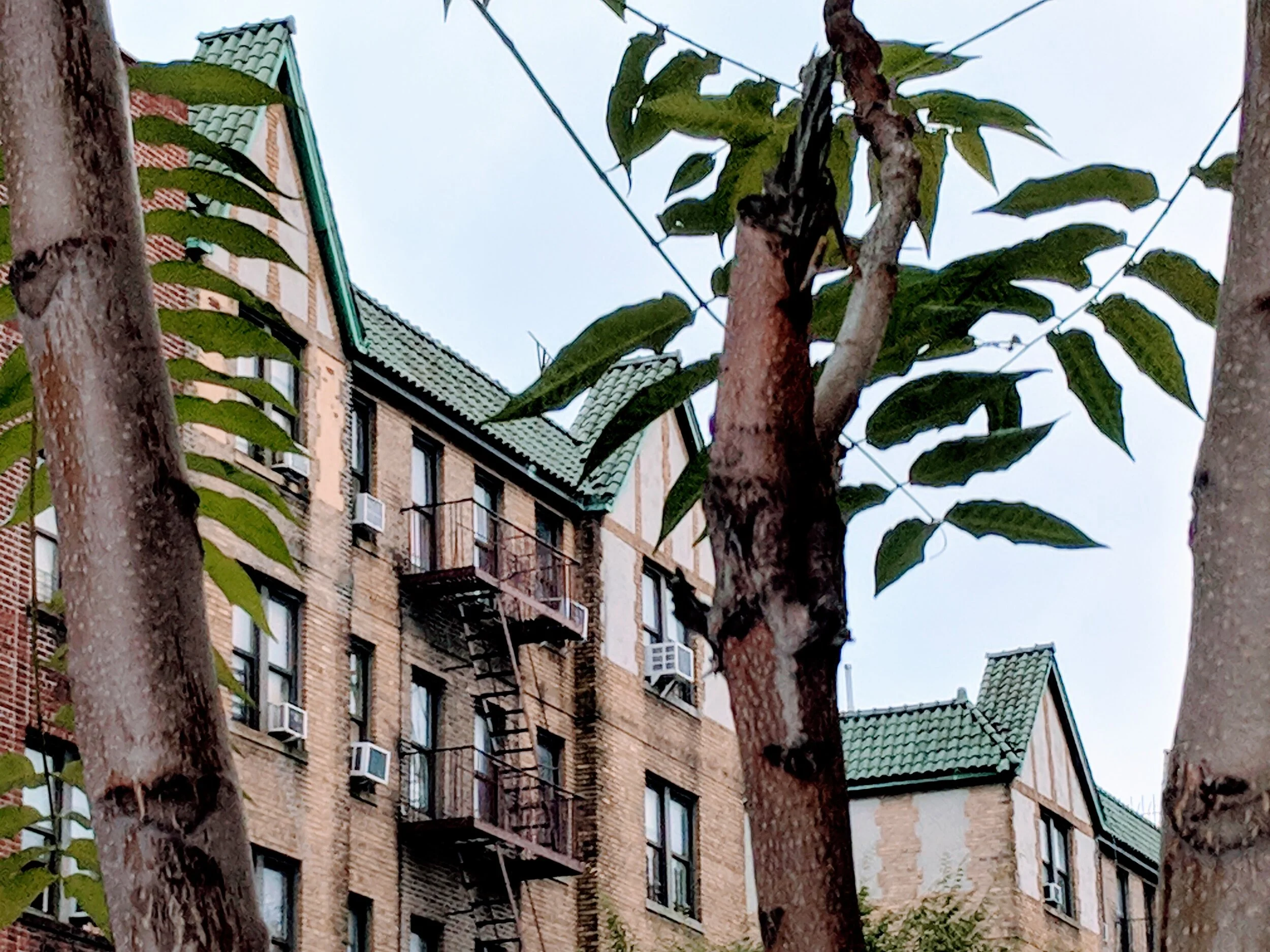
View fullsize Inwood, Manhattan
Inwood, Manhattan
View fullsize Syracuse University Hill
Syracuse University Hill

Our current growth patterns are unsustainable in every way. Instead we should be aiming to provide more variety in our housing options and to reduce our excesses by focusing on infill projects. In most communities your only housing options are either a single-family detached home or an apartment. Some older cities still have row houses or semi-detached homes available. Condos make appearances throughout the country, but in small numbers. Part of this is due to the American obsession with home ownership, while other countries have focused on long-term leasing as a form of stability. We need to destigmatize renting and provide renters the same benefits that homeowners have in terms of tax deductions, as well as decoupling wealth accumulation from our homes. As stated previously, we need to remove single-family only zoning, along with minimum lot size restrictions, perhaps even instituting lot size maximums. We need to shift government subsidies away from suburban expansion and towards urban infill projects, rewarding developments that do not build excess amounts of car storage but instead invest in pedestrian and cycling infrastructure, or build along transit routes.
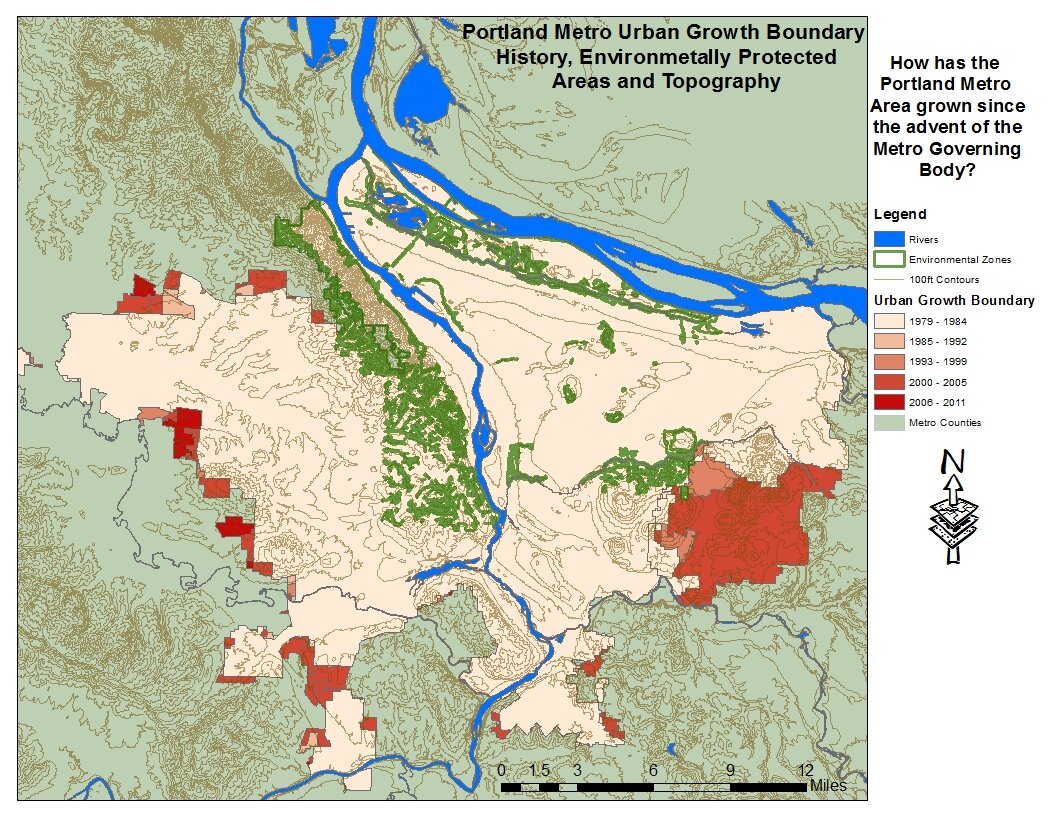
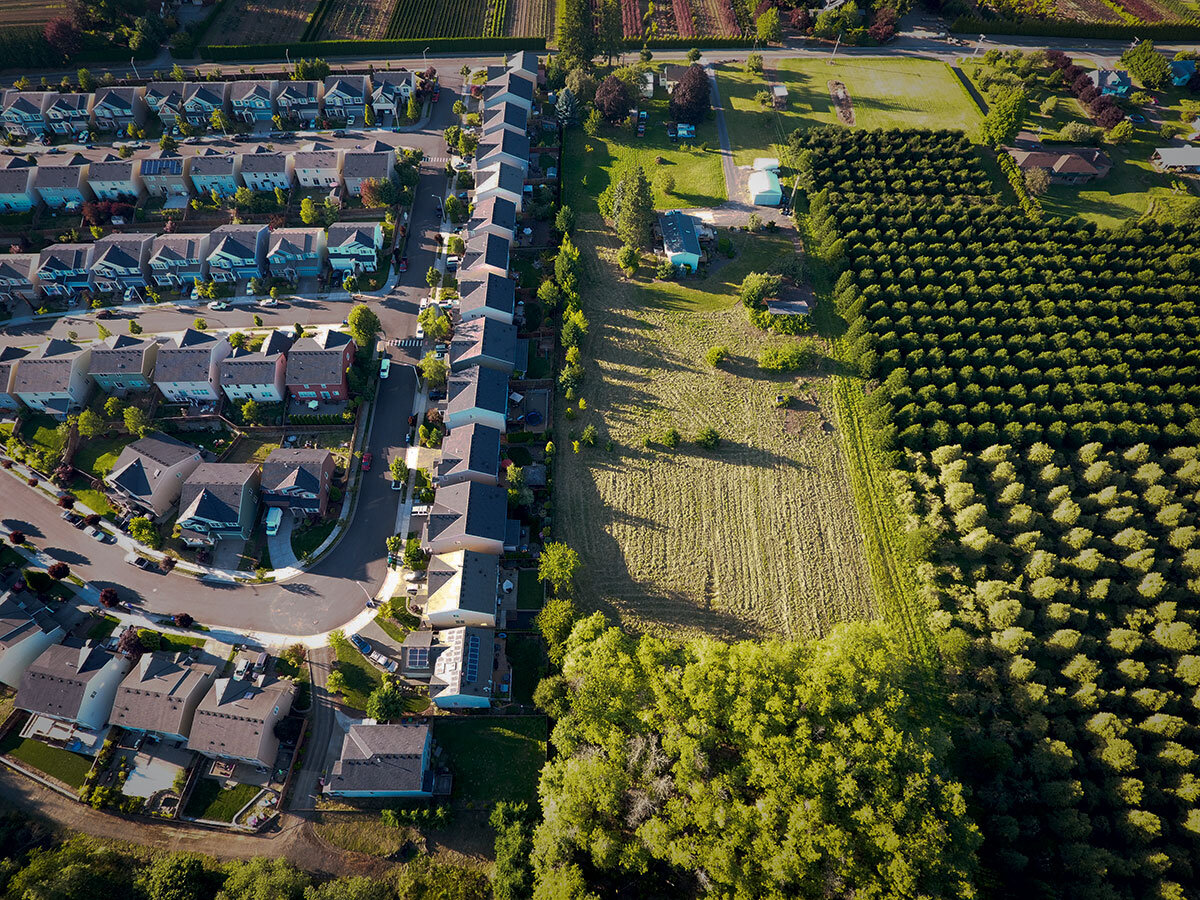
Portland's Urban Growth Boundary
Portland's Development

One final piece we need to embrace for this new housing to take hold is the urban growth boundary. Without restricting new construction to defined areas we will only continue to experience dangerous sprawl. Urban growth boundaries prevent greenfield development and encourage infill instead. The most famous American example of the growth boundary is in Portland, Oregon, but even that is too loose as most of the area inside the boundary is occupied by single-family only zoning and has been expanded fairly routinely. To give you an idea, Portland’s density (4,740 people per sq. mile) is still significantly less dense than that of Syracuse (yet it also has some of the highest bike ridership numbers in the country, proving that intense density is not needed for a bikeable city). Every Rust Belt city, and more importantly its metropolitan area, should have a growth boundary as populations have stagnated or declined. To have new development further away from the city without an increase in population is irresponsible environmentally and economically. It should also be significantly easier to implement in such cities, as opposed to many of the faster growing cities across the country (although it’s even more important to implement in those cities now rather than later). 

When you combine all of these policies you begin to open the door to more housing at all income levels while reducing the environmental strain. When paired with the many transportation policies already discussed in this series you begin to see a more sustainable way forward with comfortably dense communities built around walking, cycling, and transit use. This is a vision that is increasingly seen as the way out of the current pandemic without doubling down on the failures of auto oriented development of the last century.
In Climate Crisis, Urban Planning, Housing Tags Climate Crisis
Comment
Citi Bike.jpg

To Fight the Climate Crisis We Need: To Design Cities For People

July 27, 2020

For the summer of 2020 I will be releasing a series of articles reflecting on some of the things cities, and urban planners specifically, can be advocating and planning for to help in our fight against the climate crisis. These pieces will reflect on our transportation networks, the need for urban living, and protecting our natural resources while bringing them into the city. While these are not comprehensive of everything that needs to be done to turn the tide of this crisis, they will provide a different vision of what our world could be like if we commit to a different form of development.


Our current American cities, which are characterized by generally dense populations of people, are not built for those people. As I have mentioned in the previous pieces in this series, over the last century we have given over more and more space to cars while depriving people of needed public spaces. We’ve heard that it was required as our economies grew so that people could move more efficiently through our communities. High speed access to city centers and subsidized car storage once there were needed to ensure the success of our cities, or so the thinking went. Turns out we bled our cities dry of what makes them unique and vital; people. In their place we pumped in toxic exhaust and destroyed our physical and economic health. Activists have tried to wrestle back some of this space for people to walk and ride bikes, pointing to successes in European cities and some American cities who have experienced minor success. Slowly we began to see bike lanes pop up here and there, but no major overhauls or increases in ridership across most of the country.

And then the pandemic hit.

Suddenly many people started to look around and notice that they didn’t have adequate spaces to get out and enjoy the outdoors in their communities. Sidewalks were in disrepair or non-existent. Bike lanes, if there were any, were filled with trash, cracked pavement, or blocked by cars. Even so, bikes sold out across the country, with many stores having months long wait lists for their next shipment. Finally, many of us were on the same page: We need to start designing cities for people. Not only will this shift benefit people on a day-to-day basis, but it will also help us fight the looming climate crisis that threatens the entire world.

View fullsize Source: NACTO
Source: NACTO
View fullsize Source: TNMT
Source: TNMT

The two charts above demonstrate some of the benefits of giving over more space to people to walk and ride bikes. Walking and biking can transport three to four times more people than mixed traffic can. Not only that, but they can do so without producing significant amounts of carbon (only really seen through the actual manufacturing of bikes). 

Before someone brings up the argument that they’ve never seen that many people on bikes in an hour, yet often see cars backed up, let’s think of why there aren’t more people riding. On your average city street you have cars driving over 30mph, rolling through stop signs, taking tight turns with little to no regard for anyone trying to cross the street (even in states like New York where pedestrians have the right-of-way, yet always seem to be running to avoid cars). Now you’re on a bike with cars driving too close to your side, pushing you towards the parked cars where someone flings open their door without looking, causing you to run into it and injure yourself when you luckily don’t get hit by the car driving less than a foot to your left. Without safe bike infrastructure most people will not feel safe using a bike as a way to get around. This doesn’t mean that people aren’t interested in riding bikes more, and in fact there’s been studies across the country that point to over half of respondents wanting to ride more but citing safety as the major reason that they don’t.

Now think about your average trips you make throughout the day; to the gym, to the grocery store, to work, out to eat, etc. While your work commute, depending on where you live, could be a decent distance, perhaps over 10 miles for some, most of those other trips are within 5 miles of your home. A study by the Transportation Research and Education Center shows that 60% of trips are under 5 miles, and close to 40% are under 2 miles. These are distances easily performed on a bike, or even walking. While grocery shopping may seem cumbersome on a bike, there are plenty of bike attachments and designs that are specifically made for moving packages, groceries, and small children.

Or you may think, we live in a place with terrible winters and there’s no way riding a bike in winter makes sense. Well, for some people that may be true, you can look to the Netherlands, Finland, Sweden, or even Canada, and find large numbers of people who ride bikes in much worse climates than our own. What it comes down to is priorities and infrastructure. Many European countries that experience harsh winters prioritize clearing snow and ice off of sidewalks and bike lanes before they ever touch vehicle lanes. This is a specific policy that elevates more efficient and environmentally friendly forms of travel over the most harmful forms of travel (private vehicles).

Example of a bike boulevard intersection. Lanes are narrow with a small rotary that fits within a traditional intersection.Source: Small Town and Rural Design Guide

Example of a bike boulevard intersection. Lanes are narrow with a small rotary that fits within a traditional intersection.

Source: Small Town and Rural Design Guide

We don’t need to have bike lanes as beautiful and heavy duty as those seen in Europe and some American cities (even though we can hopefully get more like that soon). In many communities we simply need streets that slow down cars and prioritize access to people riding bikes or walking. Bike boulevards provide opportunities to improve access with minimal interventions, primarily focused around intersections. Bump out islands and small rotaries help prevent cars from taking tight turns or speeding through intersections. As a result, people on bikes and on foot are given improved visibility that allow them to enter intersections in a safer manner with some form of barrier between them and cars. While these interventions are normally put on side streets (as is emphasized in the Rochester Bicycle Master Plan), a network of bike boulevards that connect to commercial corridors could help people who ride get to destinations safely on a parallel street.

View fullsize Buffered Lane
Buffered Lane
View fullsize Protected Lane - Curbs
Protected Lane - Curbs
View fullsize Sharrows
Sharrows
View fullsize Protected Lane - Flexposts
Protected Lane - Flexposts

Even with a network of bike boulevards, a true network of protected bike lanes is vital. Too often cities paint lines and put in a bike stencil and feel that is enough. Or, even worse, put in sharrows on busy roads. Not only do sharrows not help with safety, they have actually been seen to increase the risk of injury for people on bikes. Paint does not keep a car from hitting you, or from parking in the lane blocking your right-of-way. Parking protected lanes significantly increase the safety for people riding, driving, and walking, but are often controversial due to driver “confusion” and have been taken away after complaints of not understanding how to park. Even putting up flexposts with a buffer provides a level of comfort for riders that painted lines do not, as it’s a more visual cue about the right-of-way. Protected lanes have been shown to see 6x more growth in ridership than unprotected lanes, and they also reduce all forms of crashes, whether car-to-car or car-to-bike, by over 44%. 

We’ve seen what works and what brings people out to walk and ride more. We’ve seen cities roll out new bike lanes in a matter of days, shutting down streets to cars and seeing people flock to their newly reclaimed spaces. Yes, for Americans this will be a significant shift in our thinking and how we build out our infrastructure. But if we truly want to tackle the climate crisis, providing more safe spaces for people to ride bikes and walk is one of the most important changes we can implement. Not only will it reduce our carbon emissions, but it will also improve health, improve happiness, and provide opportunities for us to interact with one another face-to-face and make connections that help build community. We can start this change now with minimal investment; just roll out some cones, paint some lanes, and start teaching kids how to ride.

In Climate Crisis, Transportation, Urban Planning Tags Climate Crisis
Comment
BX20 bus in Inwood, Manhattan

BX20 bus in Inwood, Manhattan

To Fight the Climate Crisis We Need: To Revamp Our Transit Networks and Make Them Free

July 13, 2020

For the summer of 2020 I will be releasing a series of articles reflecting on some of the things cities, and urban planners specifically, can be advocating and planning for to help in our fight against the climate crisis. These pieces will reflect on our transportation networks, the need for urban living, and protecting our natural resources while bringing them into the city. While these are not comprehensive of everything that needs to be done to turn the tide of this crisis, they will provide a different vision of what our world could be like if we commit to a different form of development.


In the previous installment of this series, we looked at electric vehicles and their shortcomings in regards to addressing the climate crisis. We must recognize that breaking our cultural obsession with owning a personal vehicle is the only way to fully tackle the scale of this crisis. Instead, rethinking our public transit networks to work better with the modern form of our cities and making them fare free can help us avert the worst of what is predicted.

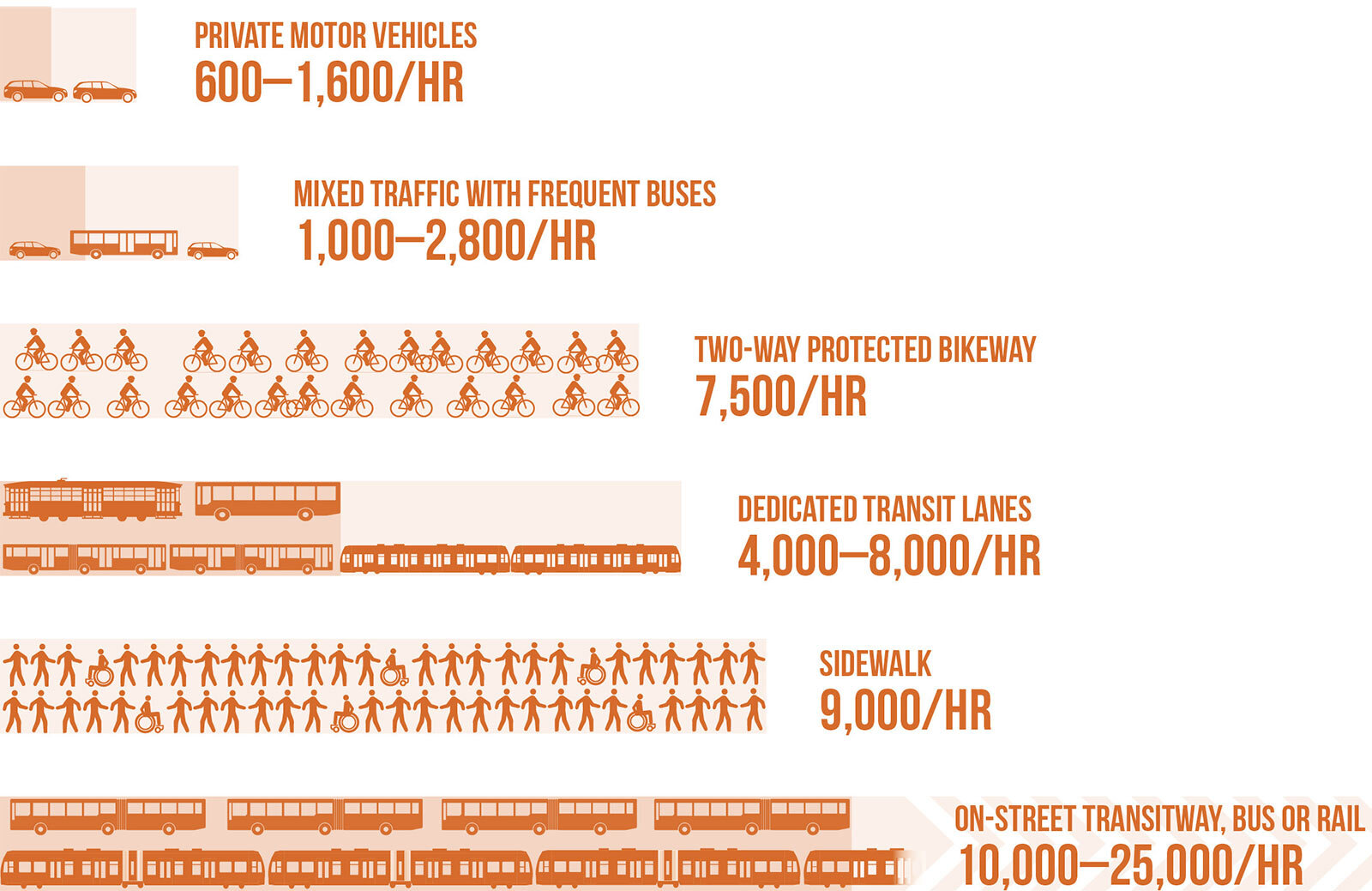
Many people will argue that autonomous vehicles will solve many of these issues and convince people to give up ownership, but we can’t wait for that technology to improve to the point where that’s even feasible. As close as we continually hear the technology is, the truth is it’s much further away as designers realize the extreme difficulty of designing a vehicle to operate in such a complex environment. Even if the technology was available and safe, the efficiency of individual cars, even if its a shared fleet, pales in comparison to a properly run public transit system, as laid out in the graphic from NACTO below.

nacto-street-capacity-diagram.jpg

Now imagine if we truly invested in our public transit systems and designed them in a way that fits our modern cities. Many of our transit networks have not been updated in decades, and often continue to follow the same paths streetcars laid out over 100 years ago. As you’d guess, no city is the same as it was 100 years ago; people live in different places, businesses have clustered in different patterns, and the pace of life has changed. Yet, only a small number of cities have taken on the difficult task of revamping their transit networks to reflect how their communities have evolved. 

Houston, Texas is usually held up as an example of a city who took on an ambitious bus network redesign that worked, reworking their network into more of a grid with frequent connections and less of a central focus on the downtown core. But mid-size cities have also started to revamp their networks, with an understanding that their central cores are no longer the only employment centers. One local example is Rochester, NY, who’s transit provider, RTS, spent the past few years rethinking how their service will work. They did their best to balance coverage and frequency (which is the central dilemma agencies must consider, and is laid out well in the book Better Buses Better Cities), ramping up frequent service on 10 routes that serve that busiest corridors, while reimagining what service could be in the outer reaches of their service area. With an on-demand service using small vans to connect to fixed route services or, for a slightly higher price, curb-to-curb service within designated zones. 

Then you can look to Albany, NY which has looked to develop some of the best bus rapid transit (BRT) lines in the country, showing that a smaller mid-size city can provide service on par with much larger cities. CDTA, Albany’s transit provider, began with the BusPlus Red Line which connects many of the region’s dense neighborhoods and employment centers, seeing ridership climb along the corridor over 20%, to nearly 4 million riders a year. Since then, CDTA has expanded BRT service along two more routes, proving that better bus service can attract riders at a much lower cost than rail service. 

View fullsize METRO Houston Bus Map
METRO Houston Bus Map
View fullsize RTS Rochester Map
RTS Rochester Map
View fullsize CENTRO Syracuse Map
CENTRO Syracuse Map
View fullsize CDTA Albany BusPlus Map
CDTA Albany BusPlus Map

That’s not to say that rail service isn’t necessary in some cities, including Buffalo, NY which I’ve written about previously, but instead it's an argument in favor of cities exploring new uses for the bus first. Boston’s MBTA has been on the forefront of implementing BRT pilot programs, showing to riders and drivers alike that bus lanes and better service can help everyone. By using traffic cones to change traffic patterns to provide designated bus lanes, MBTA has improved on-time performance and sped up buses along with shortened timelines for public outreach on capital projects by demonstrating the changes being discussed while taking in real-time feedback from riders. 

Improving service, primarily frequency (at least a bus every 15 minutes) and speed, will attract new riders and convince some drivers to switch modes, but in order to convince more people to take transit we must make it economically attractive as well. This comes in two ways; stop subsidizing driving and make transit free. 

Our current legal and economic structures highly prioritize car usage, which has resulted in the decimation of the urban core in many cities. Parking lots have destroyed once walkable neighborhoods and have pushed residences and businesses further away from one another, resulting in people needing to drive to get to their destinations. Zonings that prioritize single family detached homes, which have a deeply racial history, are some of the main culprits for this new dispersed development pattern. The impact of our housing choices will be covered in a later installment. I also won’t focus on parking too much, but the following video from Vox and this interview with Donald Shoup in City Lab help lay out the many reasons free parking, or even the very low priced on-street parking that does exist, harms our economy and our environment.

Not only does free parking benefit those who drive, workers taking other forms of transportation rarely get free transit passes or other economic benefits for walking, biking or riding transit instead of driving. Drivers also benefit from tax breaks for buying electric cars, even though those cars still cause many of the same issues gas powered cars do. There are no tax incentives towards riding transit, even if it benefits the economy/environment more. If this doesn’t show you how much our governments have prioritized driving over all other transportation methods, consider that speed limits are set by those breaking the law. Other than the maximum (usually 65 or 70) and minimum (30 in most places, unless petitioned otherwise) limits that states set, speed limits are set by the 85th percentile rule, which incentives people to drive faster so that the speed limit gets raised.

Another major issue is the artificially low price of gas, which does not take into account its negative impacts on the environment, and the gas tax. The idea of the gas tax was originally to help cover the maintenance costs of the interstate highway system, but has failed to do so. With better gas mileage and a push towards electric vehicles, the gas tax will become even less of a funding source for maintaining roads, meaning the maintenance will have to come out of the general tax funds, forcing non drivers to pay a larger share of the costs when contributing far less to the wear and tear of the roadways. Charging people by miles traveled will help with this deficit, but should also be coupled with a plan to make transit free and get people out of their cars to begin with.

If you want people to opt into transit use you must make sure it’s frequent and easy to use. Once we change our networks to function more frequently, we then want to make it as easy to use as possible. The best way to do that is to simply make it free. Free transit may reduce costs in the long run with the elimination of fare payment systems, buses spend less time idling as passengers board wasting less energy, and no need for the policing of passengers to detect fare evaders. With most transit agencies already being subsidized to some degree, it wouldn’t cost much to cover the rest. In Central New York, to make CENTRO fare free, at its current service level, it would cost around $50 per household per year in its service counties, about as much as one fill up for a pick up truck. This fee would be much higher in cities with higher farebox recovery rates, such as NYC or Chicago, but advocating for reduced prices and congestion pricing should be able to help.

Our current transportation system will never solve the climate crisis. Unless we’re willing to make bold changes to how transit works and what transportation methods we subsidize we won’t make a meaningful difference in our fight.

4 Train at 161st Street-Yankee Stadium station in the Bronx

4 Train at 161st Street-Yankee Stadium station in the Bronx

In Climate Crisis, Urban Planning, Transportation Tags Climate Crisis
1 Comment
South Salina Street in Downtown Syracuse, NY

South Salina Street in Downtown Syracuse, NY

To Fight the Climate Crisis We Need: To Accept that Electric Cars Won’t Save Us

June 29, 2020

For the summer of 2020 I will be releasing a series of articles reflecting on some of the things cities, and urban planners specifically, can be advocating and planning for to help in our fight against the climate crisis. These pieces will reflect on our transportation networks, the need for urban living, and protecting our natural resources while bringing them into the city. While these are not comprehensive of everything that needs to be done to turn the tide of this crisis, they will provide a different vision of what our world could be like if we commit to a different form of development.


So much of the hopes of the environmentalist movement seems to rely on the large scale adoption of electric vehicles. Transportation currently accounts for 28 percent of the greenhouse gas emissions in the United States, more than any other sector of our economy, and we are currently the only major economy seeing that share increase. While electric vehicles are key to our transition away from fossil fuels, they are not a silver bullet.

First we must consider the amount of infrastructure that must be built in order to accommodate a full on switch to electric vehicles. Private vehicles will require different charging times and configurations than commercial vehicles or delivery trucks. Most personal vehicles will be able to be accommodated at your home or your place of business, but the larger vehicles may need more significant infrastructure to provide the charges necessary to propel their weight. This infrastructure is much easier to build out in urban and suburban areas where charging stations can be located within a decent range for these vehicles, but may become more difficult in long distance passages many tractor trailers use each day.

We must also consider how long it will take to switch everyone into an electric vehicle, let alone electric tractor trailers that can meet our current demands. When factoring in the average length of time cars stay on the road, it’ll be at least 15 years for our current American fleet to turn over. Ensuring that those vehicles are all electric would require a huge boost in production, taxes or regulations to push people towards purchasing electric vehicles, and a quick ramp up of the previously mentioned infrastructure needed to support this change. We must also consider the fact that the production of electric vehicles takes twice as much energy as our current internal combustion engine vehicles. While each of these facts will change as general energy production becomes cleaner, battery technology must also improve to solve some of the issues with current electric vehicles.

According to a report in The Verge, the batteries currently in use for electric vehicles remain difficult to recycle and too dangerous to dispose of in landfills, as “thermal runaway” may occur, resulting in possible explosions. Without a major ramping up of battery recycling programs, along with a redesign of batteries to make it simpler and safer to remove and replace them, electric vehicles will struggle to live up to their greener promises. We must also be concerned with non-exhaust related emissions, which are caused by the wear and tear of tires on asphalt. Replacing all vehicles with electric vehicles may even increase these forms of emissions, due to the heavier weights of the vehicles, which again requires the need to improve battery technology to lighten the load.

In his book Better Buses Better Cities, Steven Higashide references a study by the Air Resources Board in California that notes that even if every car in California switched to electric, and 75 percent of the energy grid used renewable sources, driving would still need to be decreased by over 15 percent to reach their current climate goals. A similar study was conducted in Hawaii, again finding that a switch to electric vehicles was not enough to fully remove their state’s dependence on fossil fuels. s part of this we must ensure that our transit agencies move towards all electric fleets, something that Edmonton, Canada is working towards on a large scale. Their new electric fleet was designed specifically with efficiency in mind, both in terms of charging efficiency and financial efficiency (charging stations with fewer moving parts require agencies to have fewer replacements on hand, and less risk of things going wrong.) Edmonton’s transit agency understood the need for the transition and wanted to ensure that these large scale investments were made in a responsible way. While it's difficult to require private citizens and corporations to move to all electric, requiring publicly supported agencies to make the move is far easier and helps push our urban infrastructure in the direction of an electric future.

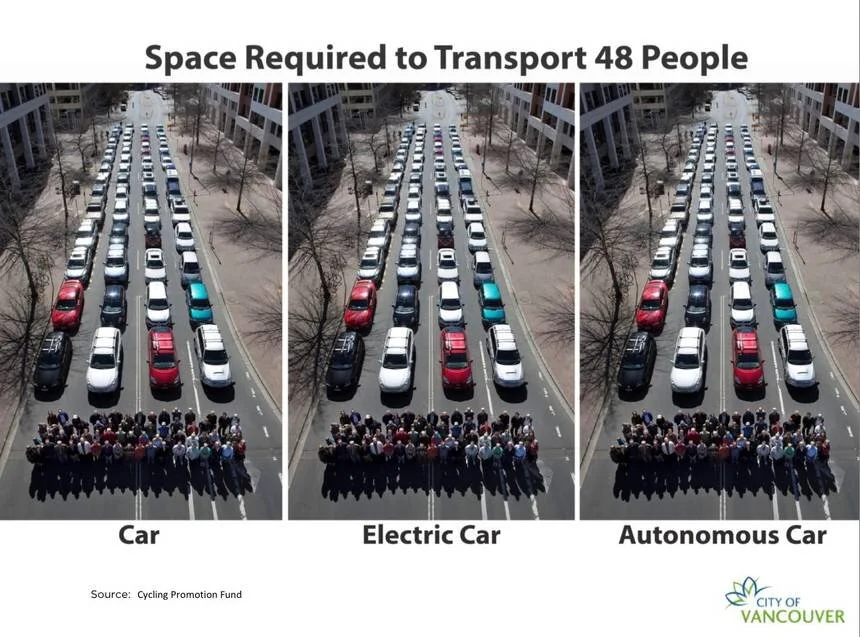
Beyond the technological challenges that must be addressed, we must also consider whether the space we currently devote to personal vehicles is healthy for cities and communities moving forward. In the image below, which has made the rounds on the internet, we start to understand that no matter what technology we develop, cars will still take up way more space to move the same amount of people than public transit or cycling infrastructure. Many will argue that autonomous vehicles will “solve congestion” but most of these scenarios assume that pedestrians won’t be around, or they’ll be penned in like animals. Anyone who envisions that as an ideal city must never have spent time in a city. People on foot are the life of cities, and everyone is a pedestrian at some point in their travels. 

Car Space on Roads.jpeg

On the other hand, you can look to Helsinki, Finland and the recognition that we must prioritize efficiency and accessibility within cities. On their hierarchy for infrastructure investment they rank personal vehicles last in terms of importance, with an understanding that urban spaces must prioritize residents over commuters. Not only does this help create spaces for communities and neighbors, which are increasingly needed, but it also demonstrates that we have the ability to make significant progress in our climate goals without waiting for technology to improve. But even in the more liberal areas of this country, advocating against the interests of drivers faces stiff opposition. The War on Cars podcast spent an episode reflecting on this blind spot in liberal policy making, but we can also see this reflected in some of the bigger climate proposals of the last few years, who rarely, if ever, question the dominance of the personal vehicle.*

All of this is not to say we don’t need electric vehicles, and in fact we need them quickly. Requiring all new vehicles to be electric would do a great deal of good in our fight against the climate crisis, but we must also work to disincentivize driving and promote other forms of travel, including both public transit and active transit options. As we’ve seen, the space given over to private vehicles must be corrected to provide space for greener, healthier forms of transportation while reducing the amount of vehicles being produced each year, helping further curb our energy needs.

*This piece has focused on the environmental impacts of electric vehicles, but there are general safety concerns that should be considered for personal vehicles, especially with the newer obsession with SUVs and trucks, which also abide by lower emissions standards than sedans due to their classification.

In Urban Planning, Transportation, Climate Crisis Tags Climate Crisis
Comment
Green Lakes State Park

Green Lakes State Park

To Fight the Climate Crisis We Need: An Understanding of What is at Stake

June 18, 2020

The climate crisis was headline news heading into 2020 with the record setting wildfires in Australia, flooding in Africa, and the increased speed of deforestation in the Amazon. By March a new existential threat, one with more immediate repercussions for many of us, took hold; COVID-19. The planet shut down, people stopped traveling, and we hunkered down to ride out one of the most widespread pandemics in modern history. As a result we began to see what might be possible when we approach a worldwide crisis with bold moves. As people stayed home, Los Angeles experienced its cleanest air in decades, cities in India were able to see the nearby mountains for the first time in a generation, and you could finally see the marine life in Venice. While we are nowhere near out of the woods with the pandemic, we should be working to ensure that the new normal we return to is better than the one we left, and that means taking on the climate crisis head first.

This summer I will be reflecting on some of the changes cities, states, and countries can take to help address the climate crisis, but to begin I want to look at some of the most devastating consequences of inaction may be.

Let’s think about some of the major natural disasters that we’ve experienced over the last several years. The wildfires in California have been some of the most devastating in history and their intensity can already be linked to climate change. California’s temperatures have risen by more than 1.5 degrees Celsius over the last century, more than worldwide average, which has lengthened the fire season by up to 75 days due to longer periods of drier conditions. Hurricane Harvey, which devastated Houston in 2017, was found to produce 38 percent more rainfall than a storm of its strength typically would if the world wasn’t warming, far more than even the original predictions of scientists. Superstorm Sandy in 2012 was one of the first major storms where scientists were able to prove a connection to climate change through the use of modeling systems. While these are American examples you can look around the world to find similar stories. Each of these stories will become less unique as time goes on, and some will look minuscule compared to what could happen if we don’t begin to act.

In 2018, the UN’s Intergovernmental Panel on Climate Change (IPCC) published a report that demanded that we make significant changes by 2030 or risk experiencing a hellish future. The Paris Agreement in 2015 had the world commit to keeping temperatures below a 2 degrees Celsius rise, with a push to cap it at 1.5 degrees Celsius. As of 2018 we were on track to exceed a 3 degrees Celsius rise. Without significant changes the world will see food shortages, water shortages, and an increased risk of all forms of natural disasters. If we have any hope of reaching those targets we must reduce our emissions by 45 percent when compared to 2010… We’ve increased them since then.

But let’s look at some of the other issues associated with climate change. One of the most discussed is sea level rise. Scientists are expecting at least four feet of sea level rise just from the warming that is already taking place across the planet. Many cities are already experiencing nuisance flooding on a regular basis, dropping home values so far that they’re unable to sell them, such as in many of the poorer neighborhoods in Atlantic City. And this rise in sea levels isn’t taking place uniformly. The below video from The Verge helps explain why the melting of the glaciers is even worse for some areas of the world, like New York. Many cities have developed plans to build up barriers to help protect against this risk, but they have been rightfully criticized for emphasizing the protection of wealthier areas while leaving poorer communities and communities of color at increased risk. New York’s Big U project will protect the southern tip of Manhattan up to the Lower East Side. While this does protect a large low income neighborhood, it does not address the issues in Eastern Queens and South Brooklyn where the majority of Superstorm Sandy’s devastation hit. Even in Atlantic City an ongoing construction project is working to protect the casinos and summer homes along the oceanfront while leaving the low income neighborhoods on the bayside of the city vulnerable.

We can also think about air pollution and the increased likelihood of illnesses that will come from climate change. Most of us picture Los Angeles or 1970s New York, or even worse would be Pittsburgh in the 1940s, when we think of smog and air pollution. Beijing famously had to deal with their smog issues before the 2008 Summer Olympics out of fear of harming international athletes during the competition. Now India is trying to get a handle on their dangerous levels of pollutants. While these are very visible signs of pollution we must consider some of the less visual signs, such as higher asthma and cancer rates. These primarily show up in less affluent communities and minority communities, the reasons for which can be traced back to many racial policies of the past. As a result of this pollution, these communities are far more susceptible to diseases, especially respiratory viruses such as COVID-19. But even if you don’t live in one of these communities, the climate crisis will increase the frequency and severity of pandemics for all of us. The warmer climate and our development patterns have shrunk the natural habitats for many wild animals, bringing us closer together, shrinking biodiversity, and increasing the likelihood of a disease transferring from one species to another.

View fullsize 1970s New York City
1970s New York City
View fullsize Los Angels
Los Angels
View fullsize 1940s Pittsburgh
1940s Pittsburgh

If all of this is still not enough to convince you, or perhaps more importantly those in positions of power, to take action, the climate crisis will also cause economic devastation throughout the world. One report from the UN estimates that the United States will see its economy shrink by over 10 percent by 2100 due to the climate crisis. Other reports have put the worldwide cost up to $69 trillion dollars during the same period. While shifting how our economies function and revamping our transit networks, electric grids, and land use policies will carry a significant cost, it will end up driving our economy in the long run. Already the solar industry in the US employs more people than the coal and gas industries combined.

Now I did not cover all of the severe impacts that the climate crisis will bring, but I hope the ones I did mention help illustrate how serious of a crisis we are facing. In the coming weeks I’ll be discussing some ways that we can begin to address this crisis, primarily focused on how our cities function and develop, with an aim to begin a dialogue about what our future should look like.

In Climate Crisis, Urban Planning
Comment
← Newer Posts Older Posts →

Recent posts

Featured
PXL_20250830_182821521.jpg
Sep 15, 2025
Urbanism Lessons from the Great White North
Sep 15, 2025
Read More →
Sep 15, 2025
Carousel.jpg
May 27, 2025
Destiny USA and the City
May 27, 2025
Read More →
May 27, 2025
PXL_20240805_141743149.jpg
Jan 1, 2025
All Cities Are Beautiful
Jan 1, 2025
Read More →
Jan 1, 2025
PXL_20241005_135224129.jpg
Nov 6, 2024
A Healthy Future for the Regional Market
Nov 6, 2024
Read More →
Nov 6, 2024
PXL_20240728_191254239.jpg
Jul 31, 2024
Renters Matter, Too
Jul 31, 2024
Read More →
Jul 31, 2024
Vista view.jpeg
Mar 21, 2024
The Valley of the Sun - A Land of (Sub)Urban Extremes
Mar 21, 2024
Read More →
Mar 21, 2024
Manlius Cinema.jpeg
Jan 31, 2024
The Movie Theater at the Urban Core
Jan 31, 2024
Read More →
Jan 31, 2024
Clinton Square Christmas Tree at night.jpeg
Nov 30, 2023
The Case for a Holiday Village
Nov 30, 2023
Read More →
Nov 30, 2023
PXL_20230817_220739294.jpg
Oct 31, 2023
The Walk: To Middle Ages
Oct 31, 2023
Read More →
Oct 31, 2023
Ballpark.jpeg
Sep 7, 2023
The Walk: To the Ballpark
Sep 7, 2023
Read More →
Sep 7, 2023
PXL_20230813_213112525.jpg
Aug 14, 2023
The Walk: To Tipperary Hill
Aug 14, 2023
Read More →
Aug 14, 2023
Arts and Crafts Festival 2023.jpeg
Jul 31, 2023
The Walk
Jul 31, 2023
Read More →
Jul 31, 2023

Powered by Squarespace